Yemen's rooftop solar in wartime: what it supplied, where it fell short, and the water cost
Syria has not had more than four hours of state electricity a day for years, according to an Associated Press report from July 2025. In the gap, households with savings or debt have bought panels and batteries. One Damascus resident told AP about borrowing thousands of dollars in 2019 for a single panel, which let the household charge a phone and run a refrigerator.
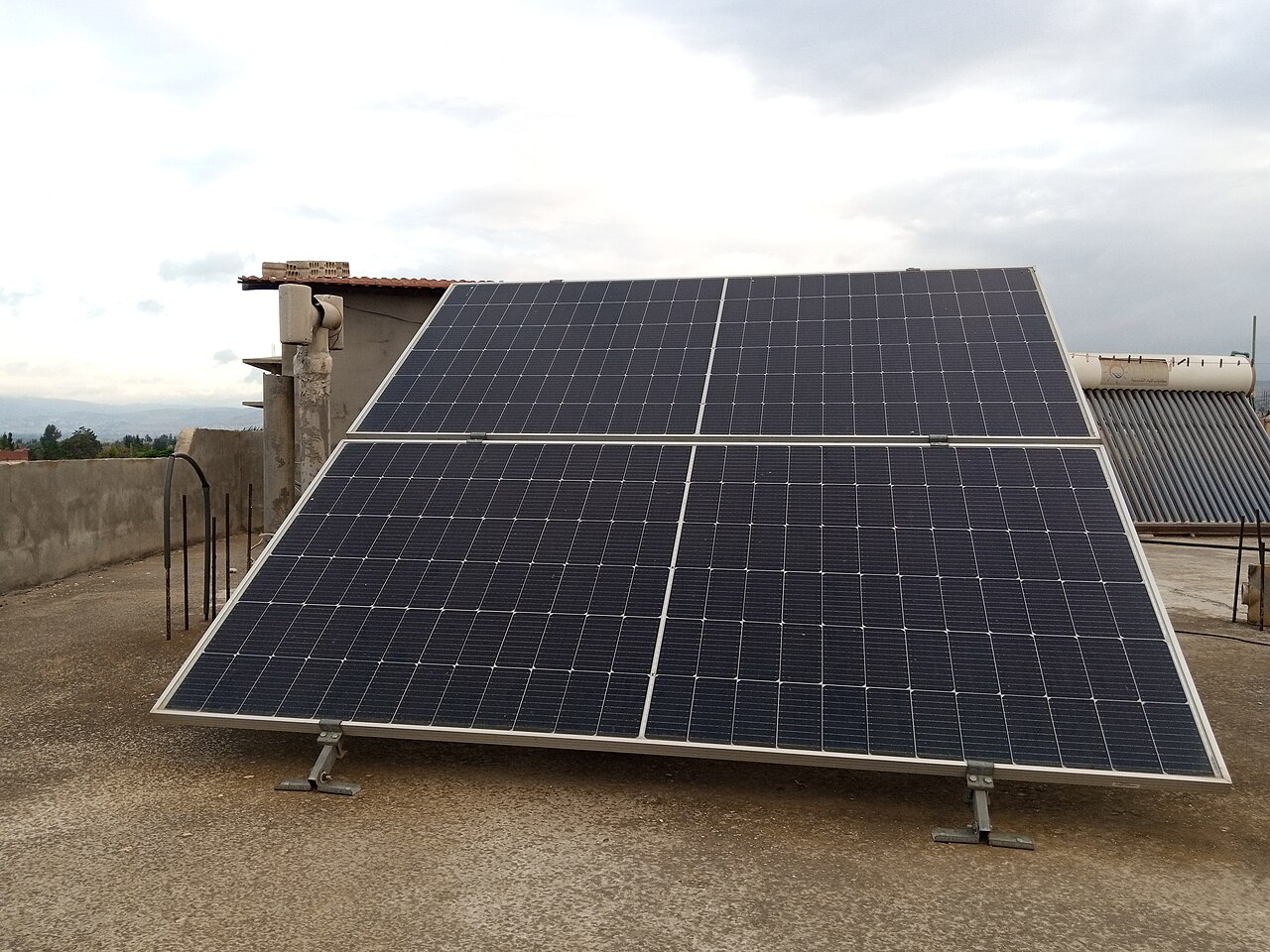
Four solar panels on a concrete rooftop in rural Homs, with a solar water heater beside them. Hayan Alhasan, CC BY-SA 4.0, Wikimedia Commons.
Yemen's grid collapsed in 2015, and what followed has been studied by a Berlin economic institute, by the World Bank and by an environmental observatory. Their findings differ in strength.
Importers and electronics shops
In March 2015 the power plant at Marib, which supplied most of Yemen, went offline. According to a World Bank blog written by one of its own energy specialists, several firms then began importing cheap solar systems, and many small electronics retailers started selling them as demand rose. On the blog's account, the private sector stepped in where public utilities had stopped working: traders and shopkeepers built the supply chain.
The Bank's team could not visit the country, so it pieced together a picture from satellite images of power assets, a survey of people receiving a cash-transfer programme, and a World Food Programme phone survey that reached mainly richer urban households. The satellite images showed nearly 55 percent of power assets damaged. The surveys led the author to write that more than half of Yemenis now use solar as their main source of lighting, and that rural access had improved during the war. The blog adds that poor households had no alternative, while richer ones could pay for private generators.
The DIW Berlin report of 2019, written by Dawud Ansari, Claudia Kemfert and Hashem al-Kuhlani, reached a similar estimate by a different route: about 75 percent of the urban and 50 percent of the rural population receiving solar power. Both are estimates built from patchy surveys, and neither is a census.
What the 2017 survey found
The same DIW report describes a turn after the first rush. Growth stalled from 2017. In a 2017 survey it cites, only one in ten households with solar systems said their supply was enough, and most used the panels only for lamps and a television. The authors attribute the disappointment to unskilled technicians, missing quality controls and the absence of technical standards, and they say observers report price-fixing between importers.
Batteries were the weak point. The Ministry of Electricity put the average life of an off-grid battery in Yemen at 16 months, against five years as the international standard, and DIW says most systems lose performance within six months. Households often bought the cheaper option from non-specialist shops, sometimes using car batteries. DIW writes that they did so without knowing how much performance they would lose.
A programme built on lenders and installers
Between 2018 and 2022 the World Bank financed the Yemen Emergency Electricity Access Project with a US$50 million grant, run by UNOPS together with microfinance institutions, solar suppliers and technical firms. Instead of handing out equipment, the project helped regulated microfinance lenders add small energy loans to what they offered, and it paid part of the price of high-quality small systems.
By the Bank's own count, 91,715 households in rural and peri-urban areas acquired these systems, a fifth of them headed by women. It also reports solar systems for 517 critical facilities: 234 schools, 220 health centres, 23 COVID-19 isolation units and 40 water wells.
This comes from the Bank's results brief, so it records what the project delivered. It does not say how long the systems lasted, and the sources opened for this piece contain no independent check. The brief itself concedes the problem the project set out to address: consumers who chose cheaper, low-quality systems often saw them fail after a few months, and health and safety practice was absent among nearly all contractors when the project began.
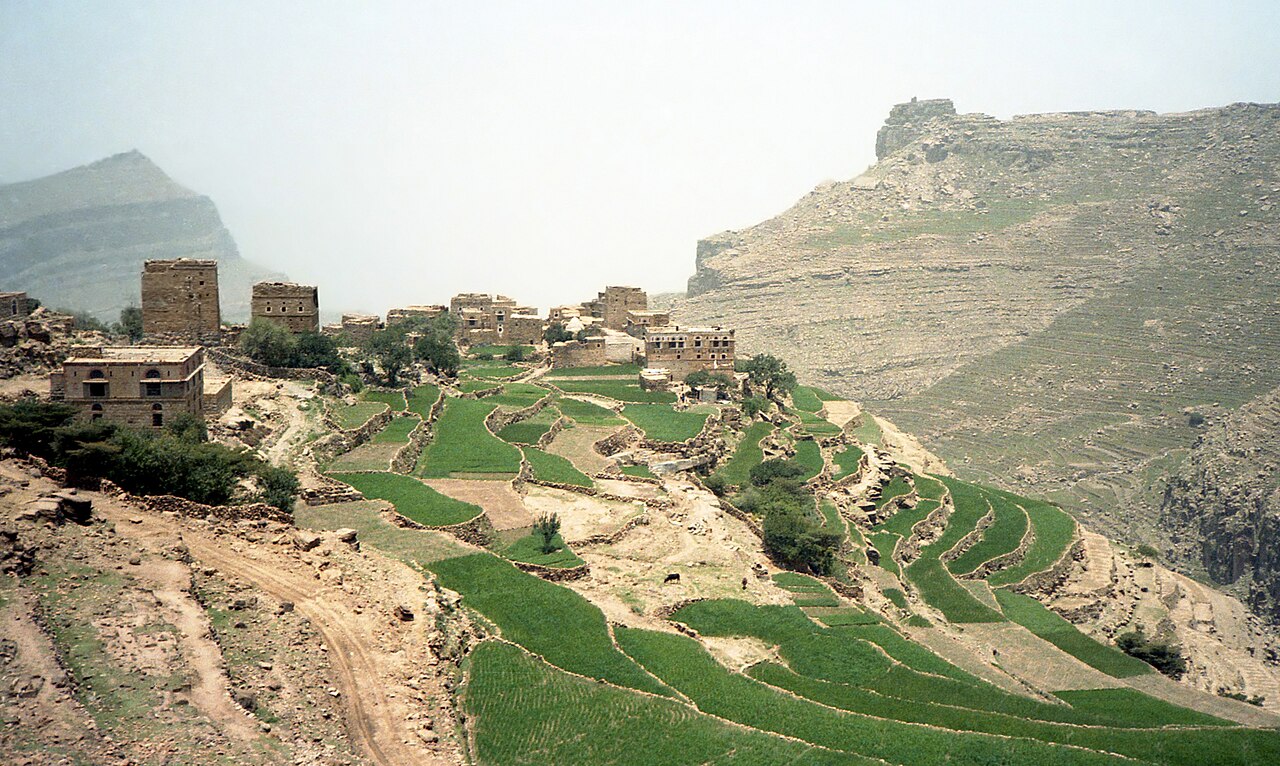
Green agricultural terraces below a stone-built village near At Tawilah, Yemen. Bernard Gagnon, CC BY-SA 3.0, Wikimedia Commons.
Pumps that no longer needed diesel
A 2021 report from the Conflict and Environment Observatory (CEOBS) looked at what happened when farmers also switched to solar, this time to pump water. The authors used satellite measurements of gravity and soil moisture for western Yemen, where most people live. They found groundwater at its lowest since satellite records began in 2002, and they hypothesise that solar is breaking the old link between diesel prices and how much water is pumped.
The word "hypothesise" matters. The authors say data on how much solar pumping exists is limited, so their account is an inference from satellites and interviews, not a count of pumps. Their suggestions include reviving the country's ancient water-harvesting systems. Yemen's aquifers were already being drawn down faster than rain refilled them before the war.
Two starting points
Syria differs from Yemen in ways the sources show. For a grid-repair grant in June 2025 the World Bank described supply as limited to two to four hours daily. Syria's energy minister told AP that the aim is securing enough power for families through the national networks, and the government has announced large generation projects. An economist quoted in the same report said panels and private generators remain available only to a few, and AP puts poverty at about 90 percent of Syrians.
DIW also made a proposal about what could come after the first wave of household panels: link existing home systems into local networks. Its own calculations put such a network at a four-fold higher supply at less than half the cost per unit. That is a calculation, not a result. None of the sources reports a Yemeni neighbourhood that has been through it.
What the sources cannot say is how Syria's own solar market is doing now. The Yemen sources are from 2019 to 2022, I could not open Syrian local reporting on installation quality or prices, and I found no independent study of how long the World Bank-supported systems lasted.